
Kootenai County Sex Offender Checks
The Idaho Central Sex Offender Registry, maintained by the Idaho State Police Bureau of Criminal Identification, is the authoritative public source. Kootenai County does not replace it with a separate public database. County sheriffs gather and verify local registration facts, and ISP gives the public central access. A county search shows entries tied to Kootenai, while name, city, ZIP, and map modes narrow a known person or area.
Start with stable facts such as a full name and approximate age. Compare the photograph, birth date, physical description, offense, address, status, and verification agency. ISP warns that an alphanumeric match is not fingerprint verification. Only fingerprints can positively connect an identity to a registry record. If a profile may be wrong, contact the listed verifier or Kootenai County Sheriff's Office. Do not confront a registrant.
The county and state channels have different jobs. KCSO handles local registration and verification work at its Government Way office. ISP BCI keeps the central database and publishes the public interface. A question about search behavior or statewide display belongs with ISP, while an appointment, local check-in, or suspected Kootenai compliance issue belongs with the sheriff. That split matters when a reader sees an old address or a pending label. Sending the issue to the office that controls the source record is faster and safer than treating a web result as final.
Five Kootenai Offender Search Routes
Idaho provides separate search routes because no single query answers each safety question. A county list gives broad Kootenai County coverage. A name search helps when a person is known. City and ZIP searches focus on a smaller place. The map begins with an address and searches a radius. Quick links also identify violent sexual predators, noncompliant registrants, and pending entries.
Use at least two modes when the result matters. Someone without a fixed home may not appear at a map point. A person living outside Idaho but working in the state may also be absent from a residential radius view. Name, city, county, or ZIP results can fill those gaps. The Subscribe tab may offer address or proximity notices. An alert is a useful supplement, but it cannot guarantee that every relevant person will map.
Idaho Central Sex Offender Registry Searches
Open the official Idaho registry search and read its terms. ISP supplies the portal while sheriffs verify local data. Begin broadly, note which mode produced a candidate, and open the complete profile instead of relying on a result-row name.
- Open the ISP registry and accept its conditions of use.
- Choose name, city, county, ZIP, or map mode. Select Kootenai in county mode.
- Compare candidates with known names, photographs, birth dates, and physical details.
- Read the full offense, address, status, and verification-agency fields.
| Field | Type | Required | Use |
|---|---|---|---|
| Last Name | Text | Yes in name mode | May be narrowed by first name, city, or county |
| First Name | Text | No | Narrows a last-name search |
| City or ZIP | Text or select | Mode dependent | Returns candidates tied to that place |
| County | Select | Yes in county mode | Choose Kootenai for a county-wide list |
| Address and Radius | Map | Yes in map mode | Search within 1, 3, or 5 miles |
The project image comes from the ISP search interface.
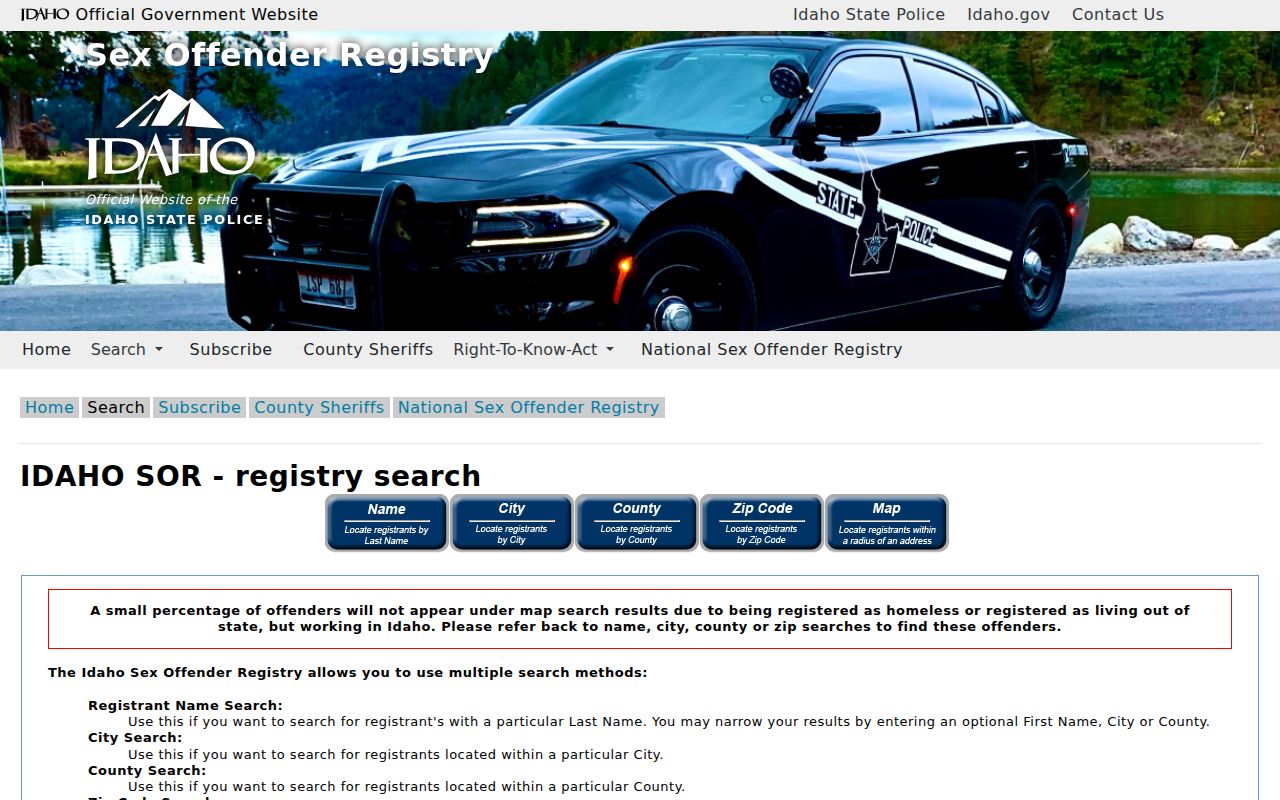
Its distinct tabs show why a county list and radius map serve different needs.
Kootenai Offender Registry Map Gaps
A blank map point is not a clean search. Idaho warns that homeless registrants may not map because they lack a conventional residence marker. People living outside Idaho but working in the state may also be absent from a home-radius view. Run the Kootenai County list and a name or city query with the map. That comparison is more sound than enlarging the radius alone.
Map distance is a search setting, not a legal finding about where someone may live. The research did not establish one Kootenai County distance rule for every registrant and location. Listed places can also change. For current facts, use the profile's verification-agency field. Report a suspected error to that custodian rather than posting it or trying to correct it in public.
Registry Profiles: What They Show
Idaho Code §18-8323 permits a profile to display enough information for identification and safety planning without exposing every field held by police. Public details may include names, a photograph, date of birth, physical traits, residence or habitual location, school address, temporary lodging, registering offenses, conviction place, compliance status, and verification agency.
| Name & Aliases | Current, prior, and alternate names released for identification |
|---|---|
| Photo & Description | Current photograph and listed physical traits |
| Registered Location | Residence, habitual location, school, or qualifying temporary lodging |
| Offense & Conviction | Registering offense, other sex-offense convictions, and conviction place |
| Public Category | Violent sexual predator, noncompliant, or pending label when applicable |
| Status | Compliance or pending status and the verifying agency |
Social Security numbers, driver's-license numbers, telephone numbers, online identifiers, and other law-enforcement-only details stay off the public profile. A missing private field does not mean the agency lacks it. It means the field falls outside the public display approved for community notice.
Read each field in context. The offense description identifies the conviction tied to registration, not a new allegation. A pending label is not a substitute for the underlying agency record. The photograph and physical description help separate people with similar names, but they still do not equal fingerprint identification. Temporary lodging can appear when statutory conditions are met, and habitual-location information can be used when a standard residence address does not fit. These distinctions explain why a short result list is only the start of a Kootenai County registry review.
Kootenai Registry Verification Agency
The verification-agency line identifies the office tied to the registration entry. For a Kootenai County registrant, it may direct a reader to the Sheriff's Support Bureau or another agency. This field is the best route for a suspected address, status, or compliance error. ISP maintains the central system, but the verifier is closer to the underlying check-in record.
Kootenai registration occurs through the Sheriff's Support Bureau sex-offender function at 5500 N. Government Way, Coeur d'Alene, ID 83815. Call 208-446-1300 for appointment, fee, and verification instructions. The county budget identifies a Sex Offender Registry Specialist, confirming the local function. Send tips about possible noncompliance to KCSO. Members of the public should not visit a home or investigate a registrant.
Registration Levels and Duties in Idaho
Idaho's public registry is not a simple federal Tier I, II, and III directory. The portal separately marks violent sexual predators, noncompliant registrants, and pending entries. Duration depends on offense and status under Idaho Code §§18-8307 through 18-8312. Many adults have lifetime duties. Some may petition for release only after meeting statutory eligibility and waiting rules. Juvenile registration follows chapter 84.
| Public Category | Duration | Verification |
|---|---|---|
| Violent Sexual Predator | Controlled by current offense and status statutes | Follow the sheriff's current schedule |
| Noncompliant | A status label, not a fixed term | Contact the listed verification agency |
| Pending | A processing status, not a tier | Recheck the live profile and agency record |
The research did not expose a reliable current offense-by-offense duration matrix. Use the live Idaho Code instead of assuming a universal 10-year, 25-year, or life table. Verification frequency also depends on the law and status. KCSO can give current check-in instructions, while a court decides any petition allowed by statute.
Kootenai Registry and NSOPW
Kootenai County lies near state lines, so an Idaho-only query may be too narrow. The U.S. Department of Justice's National Sex Offender Public Website searches participating jurisdictions. It supplements Idaho's portal. Each source jurisdiction still controls its record, so a national hit should lead back to the official state profile.
The manifest image shows that wider search layer.
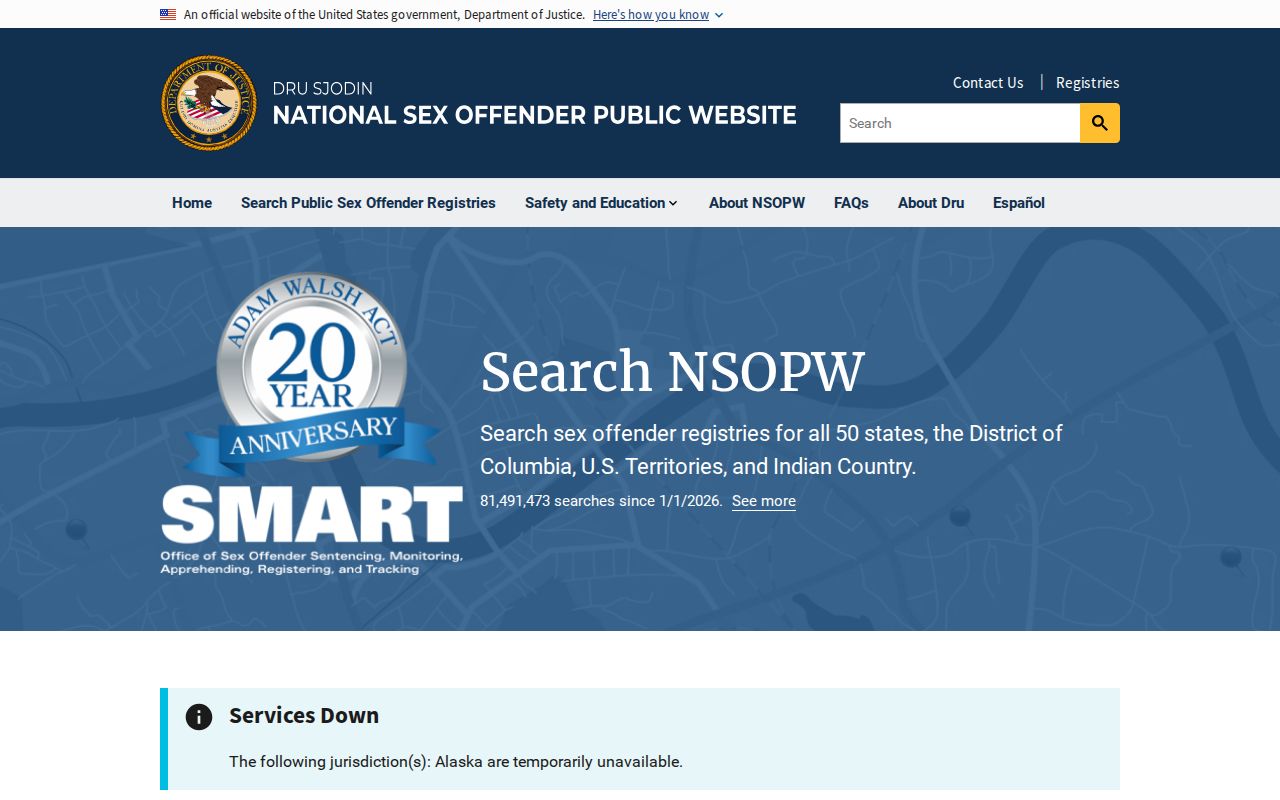
Use it to locate the source jurisdiction, then verify current facts there.
A federal custody search answers a different question. The Federal Bureau of Prisons locator can show federal incarceration, but it is not a registry and does not establish Idaho registration status.
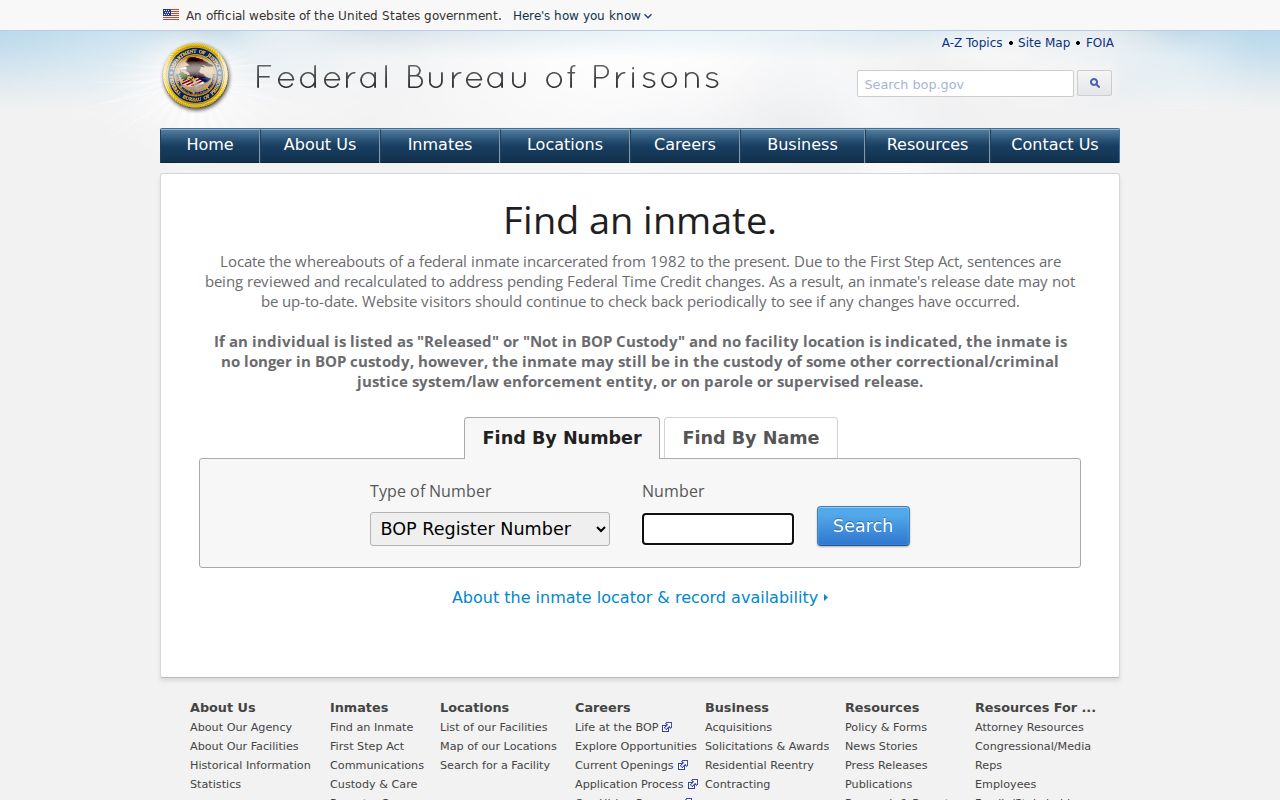
Keeping custody and registry systems separate prevents a prison result from being mistaken for a current Kootenai profile.
Kootenai Registry Law History
Idaho registration began on July 1, 1993. The Legislature replaced the original act in 1998 with the Sexual Offenders Registration Notification and Community Right-to-Know Act, and it also added a separate juvenile act. That history helps explain the shared structure still used in Kootenai County: the sheriff performs local registration and verification work, while ISP maintains statewide public access.
Older registration dates should not be read as a fixed promise about current duties. Later statutes, offense facts, court rulings, and individual status can affect the term and public category. Check the current Idaho Code and live profile. KCSO can explain present local reporting instructions, but only the proper legal process can change a registration duty.
Using Registry Information Lawfully
The registry exists for public protection and community awareness. Lawful use includes checking an area, making a family safety plan, comparing an official profile with known facts, and subscribing to available notices. It does not authorize threats, public confrontation, injury, or a campaign against a registrant or household. Keep a result tied to its official source because addresses, status, and photographs can change.
Misuse can be a crime. Idaho Code §§18-8326 and 18-8413 can support prosecution or civil liability for using registry information to injure, harass, intimidate, or commit an unlawful act.
Idaho Code §74-120 also bars using a public-record inquiry for a commercial purpose or to compile a telephone or mailing list. If a Kootenai County profile appears wrong, save its official URL and report the issue to KCSO or the named verifier. That route protects both public safety and record accuracy.
Community notice works best when the official record remains the point of reference. Recheck the profile before acting on an address or status, since the public display can change after verification. For a location near Idaho's border, compare the ISP result with NSOPW and then return to the source state. For a Kootenai entry, the named verifier remains the proper contact. Safety planning should focus on conduct, boundaries, and reliable agency information rather than rumor or an unverified name match.